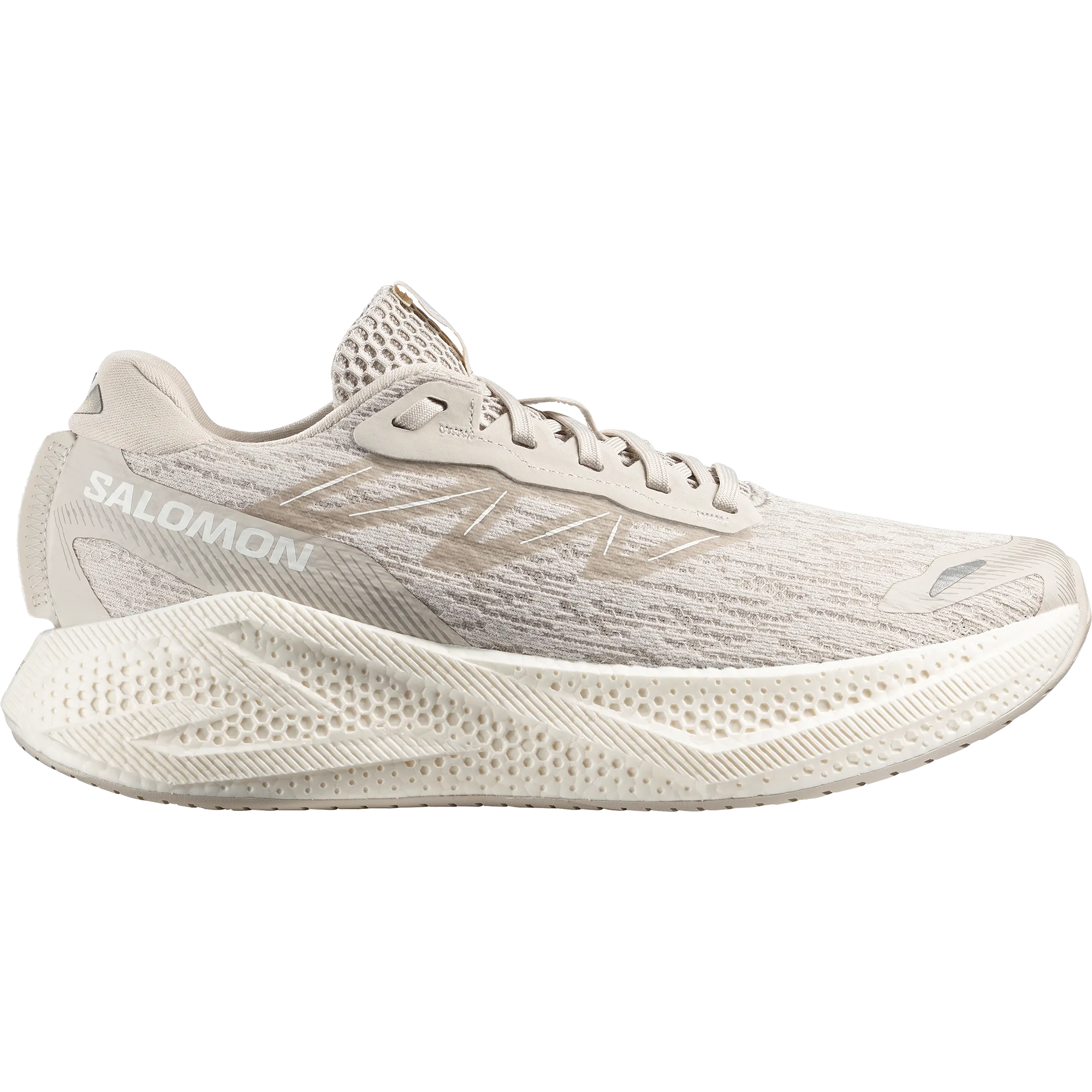
The Salomon Aero Glide 4 is a high-cushioning road shoe designed to swallow training miles without wearing your legs out. It holds the highest rating in the whole Runningix catalogue, and the lab explains why: it reaches a level of energy return normally seen only on far more expensive models. Two deliberate trade-offs: its measured drop is well above the claimed figure, and its outsole rubber wears slightly faster than average.
Measured specifications
Figures recorded in the lab by RunRepeat on a retail pair, compared with what Salomon claims. The averages quoted cover 455 road shoes put through the same protocol.
| Measurement | Measured in the lab | Claimed by Salomon |
| Weight (UK 8.5 / EU 42.5) | 255 g | 250 g |
| Drop (heel-to-forefoot difference) | 11.7 mm | 8.0 mm |
| Stack height at the heel | 43.2 mm | 41.0 mm |
| Stack height at the forefoot | 31.5 mm | 33.0 mm |
| Energy return | 72.2 % | — |
| Grip on wet concrete | 0.65 | — |
| Insole thickness | 4.8 mm, removable | — |
What the measurements reveal
Let us start with the biggest gap recorded so far on a Salomon shoe: the measured drop is 11.7 mm while the brand claims 8. Nearly 4 mm of difference. That is not a detail: a runner who picks this model because they want 8 mm actually receives a high-drop shoe, well above the market average (8.5 mm). It takes strain off the Achilles tendon and suits heel strikers perfectly, but it unbalances runners who land flat or on the forefoot.
The gap comes from the heel: 43.2 mm of foam against an average of 35.5, almost 8 mm more. The forefoot stays at 31.5 mm — generous too, but the difference between the two ends widens.
Next comes the figure that justifies the rating: 72.2 % energy return against an average of 58.6 %. The lab puts that result on a par with what it usually measures on high-end racing models sold for far more. Shock absorption follows: 152 SA at the heel against an average of 131. Plenty of cushioning and plenty of return — that combination is rare.
Another remarkable point: after twenty minutes in the freezer, the foam loses only 6 % of its flexibility, against 22 % on average. That is the best cold-weather behaviour measured across this entire catalogue. It runs the same in January as it does in June.
The downside: the outsole rubber loses 1.4 mm in the abrasion test against an average of 1.1. Salomon compensated by making it thicker (3.8 mm against 3.1), so total lifespan should stay within the norm — but the wear will show earlier.
On the road
Grip: 0.65 on wet concrete against an average of 0.52. One of the best in its category in the rain.
Stiffness: 18.3 N in the flex test against an average of 15.5 N, and 16.6 Nm in torsion against 14.5. With 43 mm of foam under the heel, the shoe does not bend — that is the normal counterpart to this stack height.
Heel hold: this is the weak point. The heel counter scores 2/5 against an average of 3. The foot is less locked down than on other shoes of the same height, which explains the floating sensation some runners report late in a run.
Tongue: bulky, but thinly padded (3.9 mm against an average of 5.8). It takes up room on top of the foot without delivering the comfort that should come with it. This is the detail Salomon should fix on version 5.
Breathability: rated 3/5 against an average of 3.6. Adequate, but this is not a summer shoe.
Upper durability: heel padding rated 5/5 against an average of 3.4. Nothing to worry about there.
Road or GRVL?
The GRVL variant went through the lab separately, and it is not just a change of outsole: on several points, it is the version that fixes the road model’s flaws.
| Measurement | Aero Glide 4 | Aero Glide 4 GRVL |
| Weight (UK 8.5 / EU 42.5) | 255 g | 275 g |
| Measured drop | 11.7 mm | 9.2 mm |
| Stack height at the heel | 43.2 mm | 40.9 mm |
| Energy return | 72.2 % | 73.6 % |
| Rubber loss in the abrasion test | 1.4 mm | 0.7 mm |
| Heel hold | 2/5 | 3/5 |
| Lug depth | — | 2.3 mm |
| Sizing | True to size | Runs slightly small |
Three differences are worth pausing on. First the drop: 9.2 mm against 11.7, even though Salomon claims 8 mm for both. If the road version’s high drop puts you off, the GRVL is far more moderate. Then durability: the GRVL’s rubber loses half as much material in the abrasion test (0.7 mm against 1.4), which settles the main criticism aimed at the road version. Finally, heel hold goes from 2/5 to 3/5.
The price to pay: 20 g more per foot, a warmer upper, and a slightly tighter fit (93.7 mm against 95.7 at the widest point) that runs slightly small — plan on going half a size up. With 2.3 mm lugs, it remains a shoe for smooth paths and gravel, not for technical trails.
One last figure, valid for both: the GRVL’s foam stiffens by only 2 % in the cold (against 6 % for the road version and 24 % on average). These are two of the best winter shoes measured to date.
When to look elsewhere
- You land on your forefoot. A real drop of 11.7 mm is a lot. Look at the GRVL variant, measured at 9.2 mm: it is the same foam in a more balanced geometry. And take the lesson of this review — compare measured drops, not claimed ones.
- You want a shoe that rolls forward on its own. The Aero Glide 4 cushions and returns energy, but its sole is not shaped as a rocker: it does not guide the foot forward. In this catalogue, the Salomon Ultra Glide 4 is the shoe that plays that role — but it is a trail model.
- You need a firmly locked heel. With 2/5 for heel-counter stiffness against an average of 3, this is not its strong suit. On 43 mm of foam, a foot that moves at the back is a foot you notice.
Sizing and width
True to size on the road version: take your usual size, the lab confirms it (the GRVL, on the other hand, runs slightly small). Be careful not to confuse two things that often get mixed up. The base on the ground is wider than average (121.7 mm at the forefoot against 115.1): that is what gives the shoe its stability despite the 43 mm stack. The internal fit, however, stays within the norm (95.7 mm at the widest point against 95.2) and narrows a little towards the toes (71.2 mm against 73.2). In other words: a stable shoe, not a wide shoe. There is no wide version in the range.
Which version should you choose?
| Version | Who it is for | Price | Link |
| Aero Glide 4 | The model tested here, men’s fit, road | from €160 | View → |
| Aero Glide 4 W | Women’s fit | from €160 | View → |
| Aero Glide 4 GRVL | Paths and gravel; more durable, runs slightly small | from €160 | View → |
| Aero Glide 4 GRVL W | Same use, women’s fit; runs slightly small | from €160 | View → |
Unless stated otherwise, the measurements in this review apply to the road version. The differences with the GRVL are detailed above.
Affiliate links — at no extra cost to you. Prices shown are the French retail prices in euros. Measurements: independent lab RunRepeat.